

Pygmy seahorses are the ultimate ‘blink-and-you’ll-miss-it’ critters: tiny, perfectly camouflaged, and built for a life spent clinging on rather than cruising around.
Most adults measure around just 1.5–2.5cm from snout to tail (think: the length of your thumbnail), and even the ‘larger’ individuals are still comfortably under 3cm.
Put side by side with a standard paperclip and the paperclip will be the biggest!
They’re also slim-bodied, so they don’t cast much of a silhouette – which is a big part of why they’re so hard to spot.
That miniature size is perfectly matched to their habitat. Rather than roaming reefs, pygmy seahorses are micro-habitat specialists: they live on very specific hosts, and their bodies are shaped and textured to disappear into them.
Many species are associated with sea fans (gorgonians) or soft corals, clinging with a prehensile tail to branches where there’s a steady current bringing food.
Others favour hydroids, algae, or rubble zones where their knobbly skin and muted colours mimic the background. They’re not fast movers – most of their day is spent holding position, pivoting slightly to feed, and relying on camouflage as their main defence.
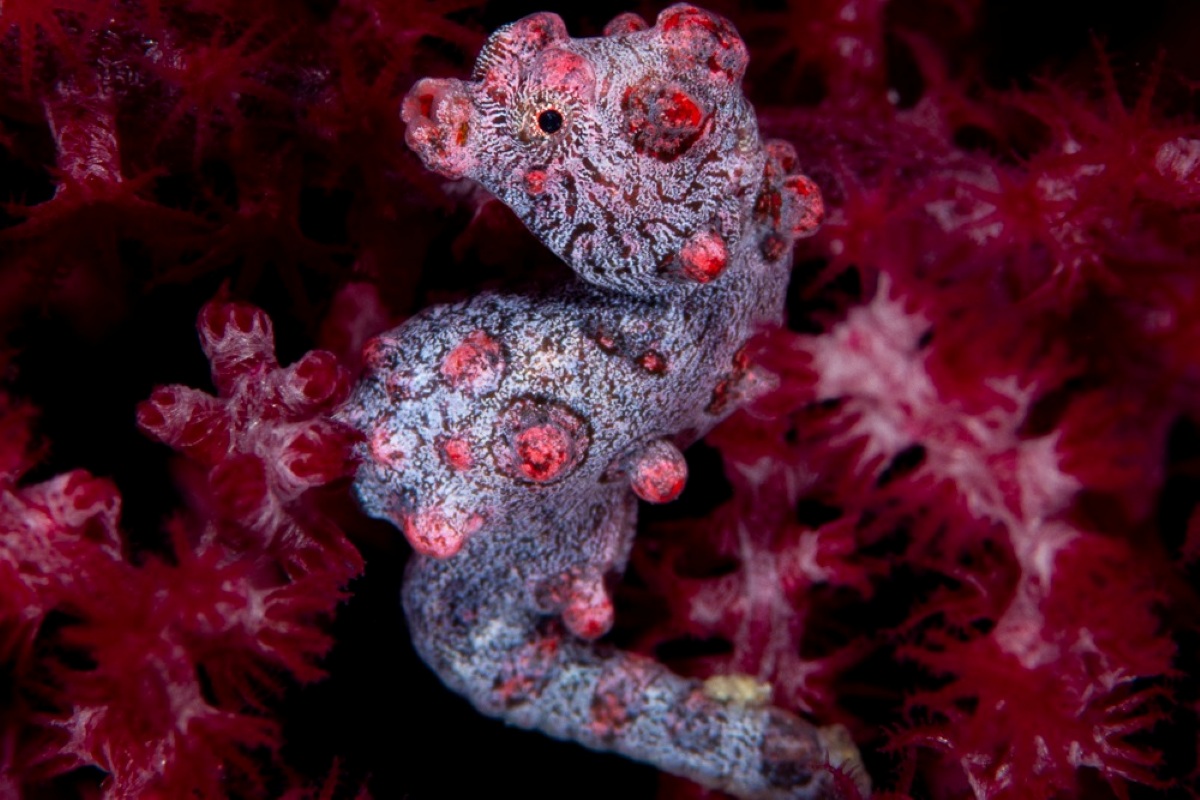
Indonesia is one of the best places on Earth to look for pygmy seahorses because it offers a huge variety of sea fans, soft corals, and sheltered reef slopes across countless sites.
You’ll often find them in areas with moderate current (enough to deliver plankton, not so much that it tears their host around). The trick is to search the host rather than the open reef: slow finning, steady buoyancy, and scanning along fan branches where a tiny bump might actually be a seahorse with its tail wrapped tight.
The Solomon Islands, too, offers a great chance to spot the little beasts. The appeal is the combination of healthy coral growth, varied topography, and excellent ‘crittery’ habitat – sea fans on sloping reefs, soft coral gardens, and protected nooks where delicate hosts thrive.
Pygmy seahorses here tend to reward patient diving and sharp-eyed guides, especially on reefs with plenty of gorgonians and complex coral structure. Because they can spend long periods on a single host, once a site has a known colony, it can remain productive – but only if divers keep their distance and avoid touching or lighting them too harshly.
They are a delight to spot and the ‘wow’ moment is real. Just go slow, keep your eyes peeled and, when you spot them, your success will be measured in millimetres.
If you would like to find out more about our itineraries in the Solomon Islands and Indonesia then contact our team at [email protected] and they will be happy to answer any questions you might have.